
A fair question — and the right place to start
As digital health evolves, a natural question emerges:
If apps already turn smartphones into stethoscopes, why does Cardiomic exist?
This is not just a valid question.
It is the question.
Because answering it reveals a fundamental distinction in how we approach the heart.
What already exists
Recent advances have shown that smartphones can capture heart sounds with surprising quality.
There are clinical and research-driven solutions exploring this space — including platforms such as Stethophone and initiatives like Vitogram. These systems demonstrate that smartphone-based auscultation is technically viable and, in some cases, suitable for clinical workflows.
This is an important step forward.
But it is not the full picture.
The clinical path
Most of these solutions follow a clear direction:
→ Detect abnormalities
→ Classify risk
→ Support medical decisions
They are designed for environments such as:
- Clinics
- Telehealth
- Professional screening
In other words:
They turn the smartphone into a medical instrument.
This is valuable — but it comes with constraints:
- Regulatory complexity
- Limited accessibility
- Episodic usage (only when needed)
Where Cardiomic diverges
Cardiomic starts from a different premise:
The heart is not only something to diagnose.
It is something to observe.
Using only the smartphone microphone, Cardiomic captures heart sounds and extracts measurable patterns such as:
- Beat-to-beat intervals (RR)
- Heart rate dynamics
- Signal stability
But the core idea goes beyond measurement.
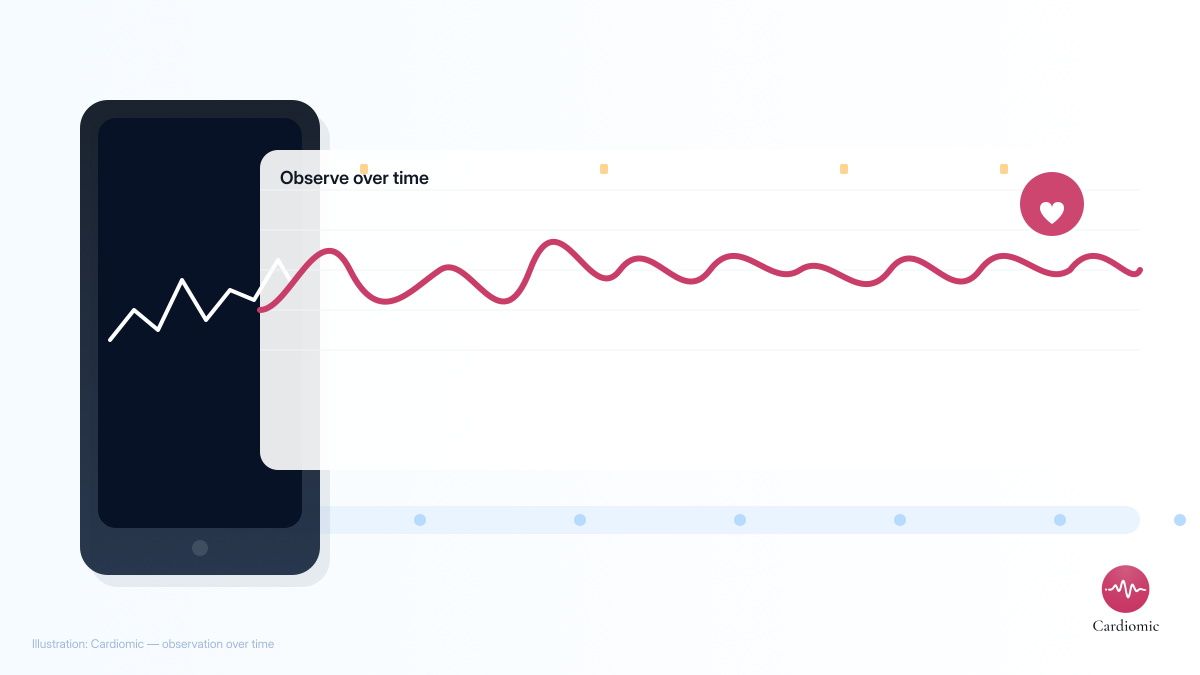
Cardiomic is designed for repetition over time.
From measurement to perception
Most tools answer a single question:
“What is happening now?”
Cardiomic introduces another:
“How does this change over time?”
This shift transforms the experience.
Instead of isolated readings, the user begins to:
- Build a personal baseline
- Compare sessions
- Notice patterns
This is not diagnosis.
It is perception.
The missing layer in digital health
There is a gap between:
- Raw physiological signals
- Clinical interpretation
That gap is where people actually live.
Cardiomic operates in that space — not as a medical device, but as a personal instrument.
An instrument that allows anyone to:
- Listen to their heart
- Observe its behavior
- Develop familiarity with their own physiology
Why this matters now
Two things changed:
- Smartphones became sensitive enough to capture heart sounds
- Signal processing made it possible to extract meaningful structure
This enables something new:
A continuous, personal relationship with a signal that was previously inaccessible.
A different kind of health technology
Many technologies aim to detect problems.
Cardiomic aims to build awareness.
It turns the heart into something that is:
- Audible
- Observable
- Trackable over time
Without requiring additional hardware.
Without requiring a clinical setting.
Final thought
The future of health will not be defined only by better diagnostics.
It will also be defined by better relationships between people and their own bodies.
Cardiomic is an early step in that direction.
Not as a replacement for medical systems —
but as a complement to human awareness.