
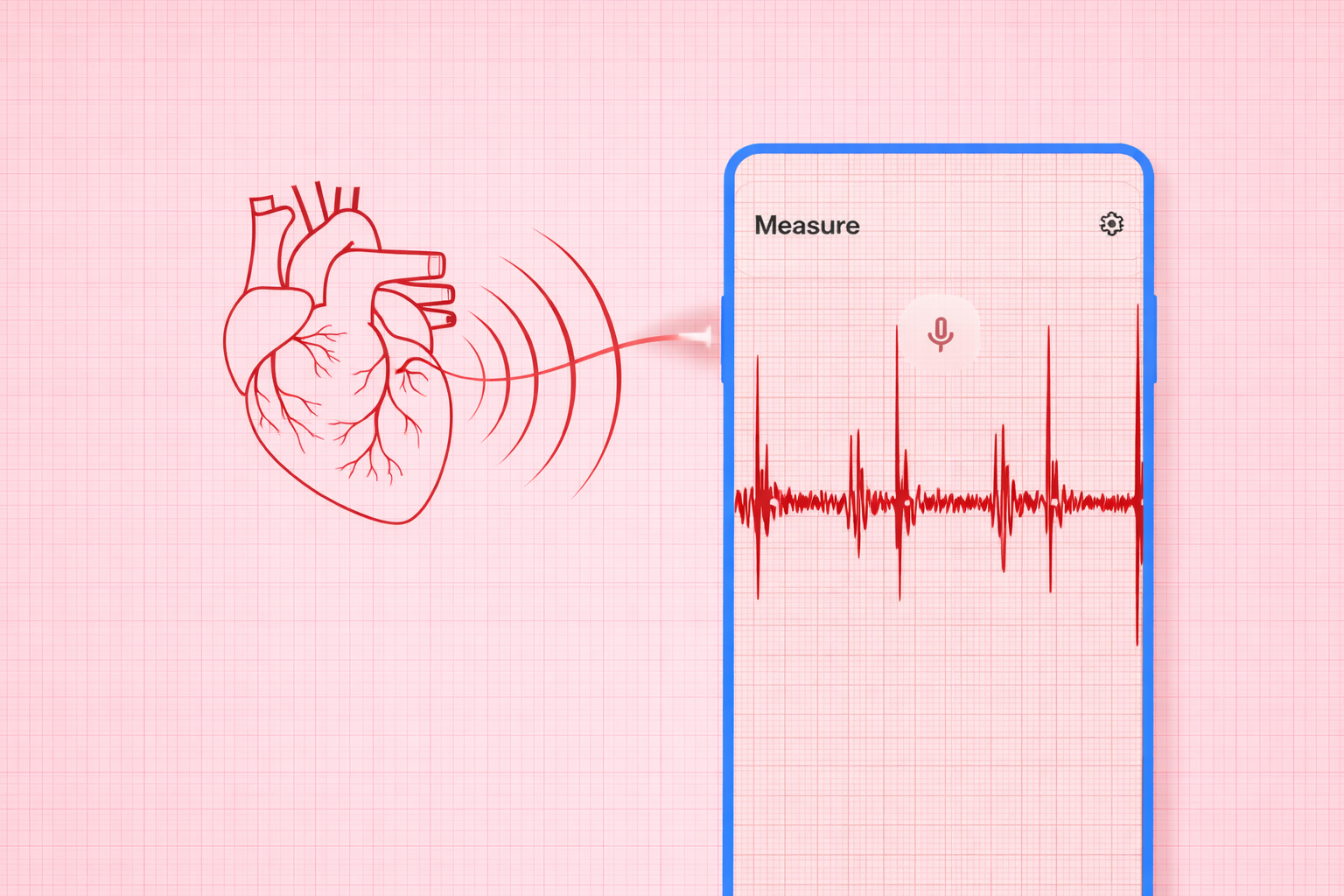
A new way to observe the rhythm of the heart
The human heart beats roughly 100,000 times every day.
Most of these beats occur without our awareness. We notice the heart only in specific situations—during intense exercise, moments of stress, or when a physician listens through a stethoscope.
For centuries, observing the heart required specialized medical instruments. Electrocardiograms and stethoscopes allow physicians to study the heart with great precision, but these observations usually happen only during brief examinations.
The heart itself, however, is not something that appears only during medical tests.
It is a continuous rhythm.
The sound produced by a heartbeat
Each heartbeat generates small mechanical vibrations.
These vibrations are created mainly by the closing of heart valves and by the movement of blood through the chambers of the heart. Through a stethoscope, physicians hear them as the familiar “lub-dub” pattern.
In physiology, recording these sounds is known as phonocardiography.
A phonocardiogram is simply an acoustic recording of the heartbeat that can be visualized as a waveform. Traditionally, this required dedicated medical sensors.
Today, the microphones built into modern smartphones are sensitive enough to capture subtle acoustic signals under the right conditions.
When a smartphone is placed near the chest in a quiet environment, it can record faint sounds produced by the beating heart.
From sound to rhythm
Once the audio signal is recorded, signal processing can detect the timing of individual beats.
From this information it becomes possible to estimate:
- heart rate
- the interval between beats
- general rhythm patterns
A single recording reveals only a brief moment. But the heart constantly adapts to breathing, activity, stress, and recovery.
Because of this, the most interesting observations often appear over time.
Repeated recordings can reveal how the rhythm of the heart changes across different moments of daily life.
Cardiomic
Cardiomic explores the idea that smartphones can serve as simple instruments for observing heart rhythm.
Using only the phone microphone, the app records short acoustic sessions of the heartbeat and transforms them into visual waveforms. By comparing recordings across time, users can observe how their heart rhythm responds to everyday conditions such as rest, breathing, or activity.
The goal is not to replace medical examinations.
Instead, Cardiomic invites a simple form of curiosity:
to observe the rhythm that has been present in the body since the first moment of life.
A small act of observation
Listening to the heart has traditionally required a stethoscope.
Today, digital technology allows a similar kind of observation using a device that millions of people already carry.
Place a smartphone near the chest, record a short session, and observe the waveform of the heartbeat.
Sometimes understanding begins with something very simple:
paying attention to the rhythm that is already there.