A gap in medical training
Medical students spend years learning to recognize heart sounds —
yet most of them have never recorded their own.
Traditional training relies on two main approaches: listening to patients in clinical settings and studying curated or simulated audio. Both are valuable. But they share a limitation: they rarely give students a continuous, personal reference of how real heart sounds behave over time.
Real physiology is not clean, perfectly segmented, or idealized. It changes with breathing, posture, stress, and activity. Without repeated exposure to these variations in a familiar context, learning remains partially abstract.
From listening to observing
Heart sounds are the acoustic result of mechanical events in the cardiac cycle. Through a stethoscope, students learn to identify S1 and S2 and, eventually, more complex patterns. But this process is often episodic — tied to specific classes, simulations, or patient encounters.
Recording your own heart sounds introduces a different model: first-person auscultation.
Instead of relying only on external examples, the student builds a personal physiological reference — a direct, repeatable connection between internal state and acoustic signal.
This shift is subtle but powerful. It transforms heart sounds from something you occasionally interpret into something you continuously observe.
Why recording enhances learning
Recording allows repetition, comparison, and context.
A single listening session may reveal rhythm. Multiple recordings reveal variation.
- Subtle timing differences between beats become easier to perceive
- The influence of breathing patterns becomes evident
- Changes after physical activity can be directly experienced
Over time, this builds intuition — not from memorization, but from exposure.
This mirrors how perception develops in other domains: through repeated interaction with real signals, not only idealized examples.
How to observe your own heart sounds
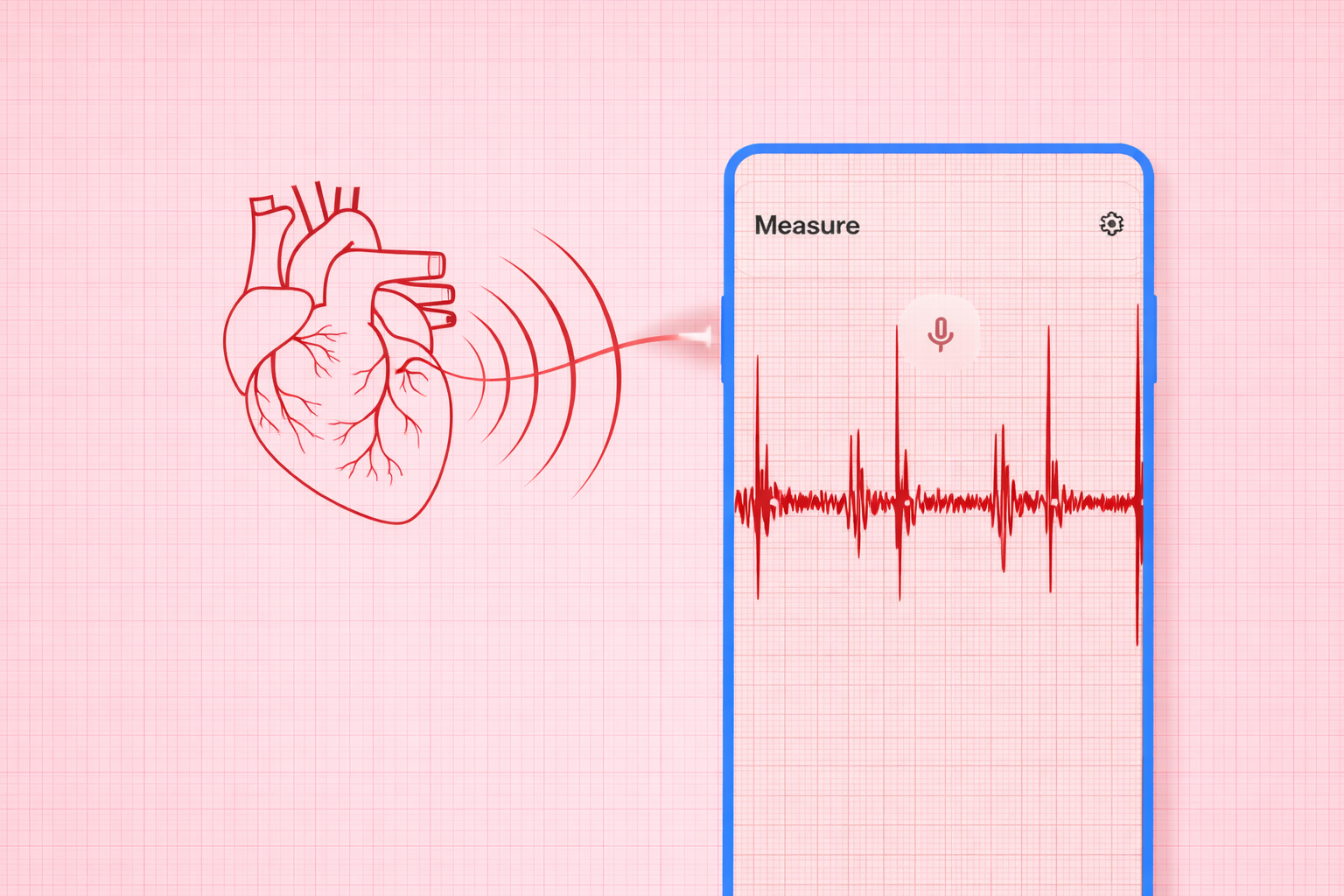
To record your own heart sounds, place a smartphone near your chest in a quiet environment. Use an app like Cardiomic to capture a short session of 20–30 seconds.
Listen to the recording and try to identify S1 and S2. Then repeat the process under slightly different conditions.
- Practice exercise: record while holding your breath for 10 seconds, then compare with normal breathing
- Practice exercise: record after light activity and compare with a resting state
The goal is not diagnosis. It is pattern recognition.
Why this matters over time
When students rely only on isolated examples, learning can remain fragmented.
A personal recording practice creates continuity.
By building a library of your own signals, you develop sensitivity to variation, timing, and rhythm in a way that static examples cannot provide. Clinical observations become easier to contextualize because they connect to something already familiar.
The first patient you can learn from — repeatedly, consistently, and without limitation — is yourself.